What Is an 850 EDI Document and How Do Growers Use Them?
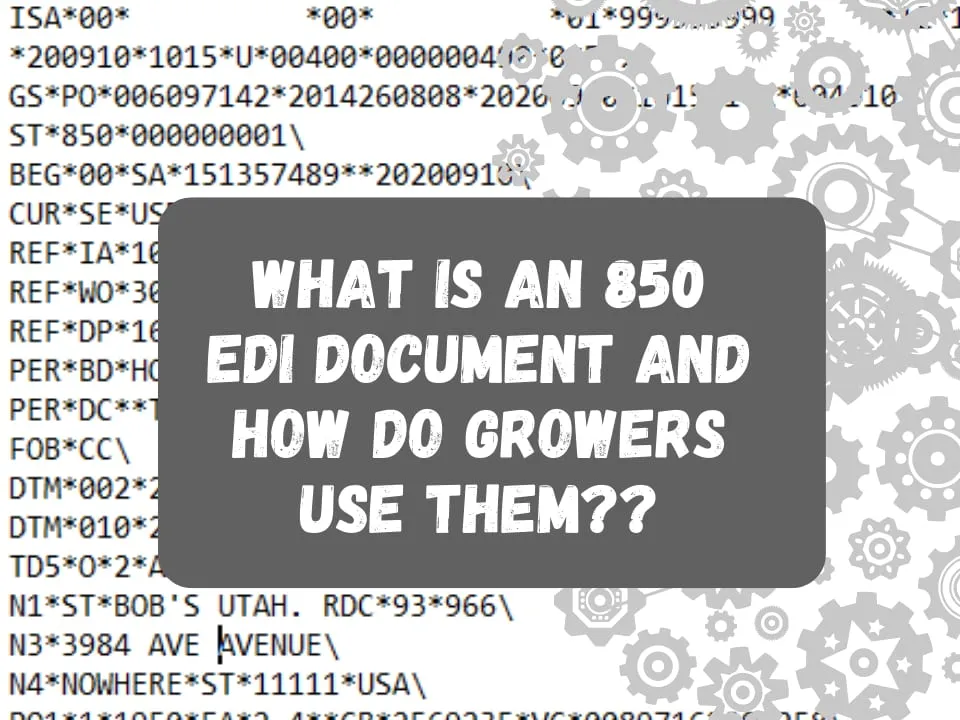
For wholesale nurseries and greenhouse growers selling to national and regional retailers, the ANSI X12 850 Purchase Order (GS*PO) is the foundational transaction of the retail order lifecycle. In live-goods horticulture, understanding how the 850 works across Guaranteed Wholesale orders and Pay-by-Scan (PBS) consignment programs is essential before the spring shipping rush begins.
Quick Scorecard: EDI 850 at a Glance
The commercial order from a retail buyer specifying store or distribution center destination, requested ship and arrival windows, item identifiers (UPC, buyer SKU, vendor code), ordered quantities, and contracted unit cost.
Partners include Lowe’s, Home Depot, Walmart, Tractor Supply, Costco, Ace, Do It Best, True Value, SiteOne, and Albertsons.
In wholesale programs, the 850 arrives days or weeks before shipping to authorize picking, rack building, and outbound 810 invoicing. Under Pay-by-Scan, the bill counts only units sold at the register; check each retailer’s guide for the documents it uses.
Some retailers recycle PO numbers across spring seasons or transmit from secondary division ISA IDs. Without a date-windowed uniqueness check and multi-ISA lookup, imports can collide with historical orders.
Side-by-Side: Plain-English Operations vs. ANSI X12 Technical Spec
The starting gun for wholesale dock picking, with distinct rules under Pay-by-Scan.
When Lowe’s, Home Depot, Walmart, Tractor Supply, Costco, or a hardware co-op sends a wholesale 850 Purchase Order, it starts the clock for your shipping dock. It tells your production and pull teams which store or regional distribution center needs plants, the requested ship and arrival dates, how many trays or pots of each variety to pull, and the contracted unit price you will bill on your 810 Invoice.
Under Pay-by-Scan (scan-based trading) programs, including Home Depot and Lowe’s scan programs, you own the plants in the store until each pot scans at the register, and settlement counts only units sold. Depending on the retailer, the buyer may generate post-scan settlement records and pay via an 820, or take an invoice built from scan data. Always check each retailer’s EDI implementation guide for its exact Pay-by-Scan document flow.
- Wholesale Role: Authorizes picking, rolling rack building, and outbound 810 invoicing (plus optional 753 routing when required).
- Pay-by-Scan: Settlement counts only units scanned at checkout; check each retailer’s guide for whether post-scan 850s or 810s apply.
- Store vs. DC Routing: Specifies direct-to-store (DTS) garden center numbers or regional cross-dock distribution centers.
- Reused PO Numbers: Some retailers reuse PO numbers across years; key orders on PO + Year + Store.
X12 850 (GS*PO) header, date qualifiers, N1 store routing, and PO1 item triplet.
An inbound 850 opens with BEG (BEG01=‘00’ original, BEG02=‘NE’ new order or ‘SA’ stand-alone, BEG03=PO number, BEG05=CCYYMMDD order date). Delivery windows are governed by DTM segments: DTM*010 (requested ship), DTM*002 (requested delivery), DTM*038 (ship no later), and DTM*001 (cancel after). Allowances or promotional discounts appear in header or detail SAC segments.
Store or DC routing is in the N1 loop (N1*ST or N1*OB with N103=‘92’ buyer-assigned store code, or SDQ destination quantity breakdowns for multi-store cross-dock POs). Each PO1 baseline item loop lists line number (PO101), quantity ordered (PO102), unit of measure (PO103=‘EA’ or ‘CA’), unit price (PO104), and a three-way item ID triplet: VP (vendor part), SK or IN (buyer SKU), and UP (12-digit UPC). Importers should resolve items with a fallback chain: Buyer SKU + Store Region -> non-empty UPC -> Vendor Part.
- Functional Group: GS01 = ‘PO’ (Purchase Order), X12 versions 004010, 004060, and 005010.
- Header & Dates: BEG (PO Number & Date), CUR*BY*USD, DTM*010 (Ship), DTM*002 (Delivery), DTM*001 (Cancel After).
- Common Refs & Store Loop: N1*ST / N1*OB (N103=‘92’ Store ID), REF*DP (for example Dept 028 Garden), REF*IA (Vendor ID).
- Line Item Loop: PO1 (Line, Qty, UOM, Price, VP/SK/UP IDs), PID*F (Description), PO4 (Pack), CTT & AMT*TT.
Verified De-Identified X12 850 Specimen
Below is a complete, de-identified ANSI X12 850 specimen modeled on wholesale nursery traffic. All trading partner IDs (0722717110100, SAMPLEGROWER), purchase order numbers (08096470), store numbers (#1242), and UPCs (043210987655, 043210987716) are synthetic reference values:
ISA*00*          *00*          *14*0722717110100  *ZZ*SAMPLEGROWER   *260414*0615*U*00406*000502258*0*P*>~
ST*850*000108501~
BEG*00*NE*08096470**20260414*90000000850~
REF*DP*028~
DTM*002*20260417~
N1*ST*GARDEN CENTER #1242*92*1242~
PO1*10*48*EA*5.25**VP*1G-HYD-END*SK*1000448219*UP*043210987655~
PID*F****1 GAL HYDRANGEA ENDLESS SUMMER~
PO1*20*36*EA*6.50**VP*1G-LAV-HID*SK*1000448302*UP*043210987716~
PID*F****1 GAL LAVENDER HIDCOTE~
CTT*2*84~
AMT*TT*486~
SE*12*000108501~
Segment-by-Segment Dual-Lens Breakdown
| Segment | In Plain English (Grower Meaning) | In Technical Terms (X12 Elements & Validation) |
|---|---|---|
ISA | ISA: Trading Partner Handshake & Sender ID Identifies which retail division sent the batch of orders and timestamps the transmission. | ISA*00* *00* *14*0722717110100 *ZZ*SAMPLEGROWER *260414*0615*U*00406*000502258*0*P*>~Fixed 106-character header. Retailers with multiple regional divisions or US/Canada entities may transmit under multiple ISA06 sender IDs; your partner lookup table must map all authorized sender aliases to the parent retailer. |
BEG | BEG: Purchase Order Number & Issue Date Establishes Purchase Order number 08096470 and the date the buyer issued it (April 14, 2026). | BEG*00*NE*08096470**20260414*90000000850~BEG01=‘00’ (Original), BEG02=‘NE’ (New Order), BEG03=‘08096470’ (Buyer PO Number), BEG05=‘20260414’ (PO Date), BEG06=‘90000000850’ (Release reference). Check BEG03 within a bounded seasonal date window so recycled PO numbers from prior years do not collide. |
REF*DP | REF*DP: Retail Garden Center Department Identifies the retail department (for example Department 028 for Live Nursery & Garden) so receiving and AP rules align. | REF*DP*028~REF01=‘DP’ (Department Number), REF02=‘028’. Often paired with REF*IA (Internal Vendor Number). Missing or mismatched REF*IA values on the outbound 810 invoice will trigger an automated 824 or 864 rejection. |
DTM*002 | DTM*002: Requested Store Arrival Date The date (April 17, 2026) the racks are requested at the garden center ahead of weekend foot traffic. | DTM*002*20260417~DTM01=‘002’ (Delivery Requested), DTM02=‘20260417’. Paired with DTM*010 (Requested Ship Date) and DTM*001 (Cancel After Date). |
N1*ST | N1*ST: Ship-To Store Identification Tells your pull team and driver which retail store ( #1242) gets these racks. | N1*ST*GARDEN CENTER #1242*92*1242~N101=‘ST’ (Ship-To, or ‘OB’ Ordered By in certain big-box dialects), N103=‘92’ (Assigned by Buyer), N104=‘1242’ (Store Number). Must map to a valid Ship-To location in the grower ERP. |
PO1 (Lines 10 & 20) | PO1: Ordered Quantity, Unit Price & 3-Way SKU IDs Line 10 orders 48 pots of 1-Gallon Endless Summer Hydrangea at $5.25 ($252.00), and Line 20 orders 36 pots of 1-Gallon Hidcote Lavender at $6.50 ($234.00). | PO1*10*48*EA*5.25**VP*1G-HYD-END*SK*1000448219*UP*043210987655~PO101=‘10’ (Line #), PO102=‘48’ (Qty), PO103=‘EA’ (UOM), PO104=‘5.25’ (Unit Cost). Item IDs: VP=‘1G-HYD-END’, SK=‘1000448219’, UP=‘043210987655’ (valid Modulo-10 UPC-12). |
PID*F | PID*F: Human-Readable Plant Description Prints the plain-English crop name on pull sheets and rack tags so dock teams can verify the tray. | PID*F****1 GAL HYDRANGEA ENDLESS SUMMER~PID01=‘F’ (Free-form text), PID05=‘1 GAL HYDRANGEA ENDLESS SUMMER’. |
CTT & AMT*TT | CTT & AMT*TT: Line Count (2 Lines), Unit Hash (84 Pots) & $486.00 Total Confirms 2 plant lines, 84 total pots ( 48 + 36), and $486.00 order value ($252 + $234). | CTT*2*84~ + AMT*TT*486~CTT01=‘2’ (PO1 count), CTT02=‘84’ (Hash total of PO102 quantities), AMT01=‘TT’ (Total Transaction Amount), AMT02=‘486’, closed by SE*12*000108501~. |
How Wholesale Orders Differ from Pay-by-Scan Programs
If your nursery ships to both wholesale accounts (such as Lowe’s, Walmart, Tractor Supply, Costco, Ace, Do It Best, True Value, or SiteOne) and scan-based consignment programs (including Home Depot and Lowe’s Pay-by-Scan programs), your team will see two distinct operating models:
- Guaranteed Wholesale (
850Before the Truck Ships): The buyer transmits the850days or weeks ahead of the requested arrival date (DTM*002). Your availability and shipping teams use that850inside Work Suite FULFILL™ to allocate salable greenhouse inventory, build rolling racks, send an855Acknowledgment and856Advance Ship Notice, and bill the shipped racks on an810Invoice. - Pay-by-Scan Consignment (Register Scan Settlement): In Pay-by-Scan programs, you own the inventory on garden center tables until a shopper scans each pot at the register, while replenishment uses daily POS scan velocity and VMI data files in Work Suite RESTOCK™. Who builds the bill depends on the retailer: some retailers self-bill from scan data (issuing settlement PO/remittance records and paying on an
820while refusing supplier810s), whereas others take an invoice built from scan data. Check each retailer’s guide before assuming which billing documents apply.
Four Production Rules Every Grower 850 Parser Should Enforce
Across production nursery EDI traffic, four technical edge cases account for most 850 import failures:
- Three-Way Item Identifier Fallback (
SK/UP/VP): RetailPO1segments include up to three item identifiers: the buyer’s SKU (SKorIN), the 12-digit UPC barcode (UP), and your vendor part (VP). When promotional or seasonal assortments omit a UPC on one line, a naive importer querying a blank UPC can match the wrong item. Resolve items using Buyer SKU + Store Region first, then non-empty 12-digit UPC, then Vendor Part. - Seasonal PO Number Recycling: Some retailers reuse
BEG03purchase order numbers across seasons. Scope uniqueness checks toBEG03+ seasonal date window (BEG05) + trading partner so a new spring order never overwrites prior-year history. - Multi-Division Sender IDs (
ISA06): Retailers operating separate regional divisions or US and Canadian entities may transmit850files from multipleISA06sender IDs. Map all authorized sender aliases to the parent retail customer. - Store vs. Distribution Center Routing (
N1*ST,N1*OB, andSDQ): Direct-to-store orders list the store number inN1*ST(orN1*OBin certain dialects), while cross-dock orders list a distribution center inN1*STand allocate store-by-store pot quantities insideSDQ(Destination Quantity) segments.
Related Guides in the Grower EDI Library
- Flagship Interactive Reference: The Ultimate EDI Guide for Growers (All 18 X12 Sets & 12 VMI Data Files)
- Order & Change Cycle: EDI 850 Purchase Order · EDI 855 PO Acknowledgment · EDI 860 PO Change
- Dock, Routing & Rack ASN: EDI 753 & 754 Routing Instructions · EDI 856 Advance Ship Notice & Rack Manifest · EDI 204 Load Tender & 816 Store Directory
- Invoicing, Pay-by-Scan & Settlement: EDI 810 Invoice · EDI 812 Credit/Debit Adjustment · EDI 820 Payment Order & Remittance Advice
- Inventory, POS & Grocery UCS/DEX: EDI 846 Inventory Inquiry/Advice · EDI 852 Product Activity Data (POS) · Grocery UCS 875, 876 & 880 · DSD DEX 894 & 895 · 997, 824 & 864 Control Gates
Silver Fern's EDI team manages live retail EDI for growers today. Open the guide, see how Work Suite fits, or book a demo.