What Is An 846 EDI Document And How Do Growers Use Them?
An EDI 846 is the Inventory Inquiry/Advice transaction set. The 846 EDI document reports what a supplier has available to sell, item by item, and it goes from the supplier to the trading partner on whatever schedule that retail program sets, so buyers can order from current numbers instead of calling to ask what is ready.
What is an EDI 846 document?
An 846 is the paperless version of an availability report. It carries the identity of both parties, the date and time the counts were taken, and a line for every item the partner cares about with the quantity you can sell against it.
Direction matters here. An EDI 850 purchase order arrives from the retailer, and the 846 runs the other way, from you to them. The standard allows the reverse, where a partner reports inventory back to a supplier, but in a grower program your availability is what goes out.
An 846 creates no obligation. Nothing in it reserves plants or commits the buyer to an order. It is a snapshot as of the date and time stated in the file.
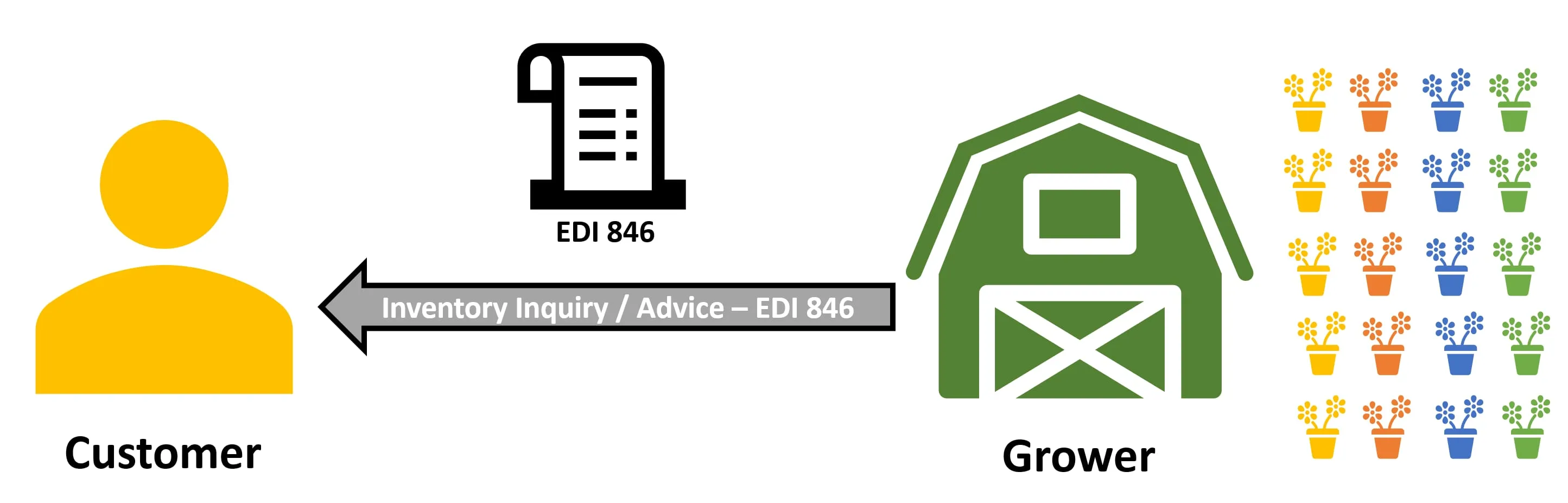
Example typical EDI flow for an EDI 846 inventory advice Copyright Advanced Grower Solutions
EDI 846 example, annotated
The 846 is exchanged in X12 format. Here is a short one from a grower to a retail partner, with made-up identifiers and item numbers:
ISA*00*          *00*          *12*5551234567     *ZZ*RETAILPARTNER  *260810*0730*U*00401*000001001*0*P*>
GS*IB*5551234567*RETAILPARTNER*20260810*0730*1001*X*004010
ST*846*0001
BIA*00*SI*AVL08101*20260810*0730
REF*IA*987654
N1*SU*GROWER FARMS LLC*92*987654
N1*BY*RETAIL PARTNER
LIN*1*UP*099999000012*VN*HYD3GBLU
PID*F****HYDRANGEA 3 GAL BLUE
QTY*17*600*EA
QTY*33*480*EA
LIN*2*UP*099999000029*VN*BOXW2GAL
PID*F****BOXWOOD 2 GAL
QTY*33*0*EA
LIN*3*UP*099999000036*VN*MUM8INA
PID*F****GARDEN MUM 8 IN ASSORTED
QTY*33*120*EA
CTT*3
SE*17*0001
GE*1*1001
IEA*1*000001001
Segment by segment:
- ISA and GS are the envelope.
GS*IBis the functional group code for inventory inquiry and advice, so the partner’s system knows what is inside before it reads the transactions.004010is the X12 version. Programs differ on whether they want 4010 or 5010. - ST*846*0001 opens the transaction set. The
0001is a control number, and the closing SE segment has to repeat it. - BIA is the beginning segment.
00says this is an original file rather than a replacement,SIis the report type code for a seller inventory report,AVL08101is your own reference for the file, and the last two elements are the date and time the counts were taken. A buyer uses that timestamp to decide how much to trust the numbers. - REF*IA carries the vendor number the retailer assigned you, which matches your file to your account on their side.
- N1*SU and N1*BY identify the supplier and the buying party.
- LIN identifies one item and opens a loop that repeats for every item in the file.
UPis the UPC andVNis your item number. Many programs also wantIN, their own SKU, on the same line. - PID*F is the free-form product description.
- QTY carries the numbers, and its first element is a qualifier saying which number this is.
17is quantity on hand.33is quantity available for sale, the one a buyer plans against. On the second item here it is zero, and that is a valid line: it tells the buyer to stop ordering boxwood until the next file arrives. - CTT*3 is the line count, checked against the number of LIN segments. A mismatch is a common reason a file gets rejected.
- SE, GE and IEA close the transaction set, the group, and the interchange.
What data an 846 contains
- Sender and receiver identity, plus your assigned vendor number (N1 loop, REF)
- The date and time the counts were taken (BIA)
- Item identifiers on every line (LIN): your item number, the retailer’s SKU, the UPC
- A product description (PID)
- Quantities by type (QTY), each tagged with a qualifier:
17on hand,33available for sale,63on order,IQin transit,20unusable - Location, where a program wants availability broken out by warehouse or distribution center
- A line count for validation (CTT)
Some programs also ask for price on the line. Which qualifiers and identifiers a program takes are set by that program, not by the standard.
How growers use the 846
The everyday use is a scheduled availability feed to a retail program, in place of an emailed spreadsheet that somebody rebuilt by hand every week.
Drop-ship and ecommerce programs are the other common case. When a retailer lists your item in its catalog and ships it from your dock, your 846 decides whether that item shows as in stock this morning.
Live goods make the cadence question sharper than it is for hard goods. Availability moves with grade-out and with what went out yesterday, so a weekly file is describing a week-old number by the time a buyer acts on it. How often you send comes down to how often you can produce a count you would stand behind.
In a pay-by-scan program the two directions work together. The 852 product activity document tells you what sold in their stores, and your 846 tells the buyer what you can supply next.
One honest limit. EDI moves your counts and has no opinion about whether they are right. If the number leaving your system is wrong, an 846 delivers it faster and more reliably than the spreadsheet did. No EDI service fixes that, and buying one for that reason will disappoint you. The fix is upstream, in whatever produces the count.
What retailers require from an 846
Every program publishes an implementation guide, and that is the specification you build against: the X12 version, the required qualifiers and identifiers, whether locations are broken out, and how often the file is expected. Cadence varies between programs, and between drop-ship and store replenishment inside the same retailer, so one partner’s setup is not a safe assumption for the next.
These windows can be exact. Our 2023 guide to Lowe’s 753 ready-to-ship document covers its cutoff mechanics; confirm current times in your routing guide. An 846 schedule is set the same way, in the program’s guide.
Many programs expect a complete file every transmission instead of only the items that changed. Under that rule, leaving an item out is not the same as reporting zero. If you mean zero, send the line with zero.
Every transmission gets an answer. As with a rejected 810 invoice, the EDI 997 acknowledgment tells you whether the partner accepted or rejected what you sent. A rejected 846 is easy to miss. Nothing bounces and no one calls, so the buyer keeps planning against your last good file until somebody notices.
EDI 846 vs 852 vs 850
The three documents get confused because all of them carry item numbers and quantities. They answer different questions and run in different directions.
- EDI 850, the purchase order. Retailer to supplier. What they want, how much, when, and to which store or distribution center. Read our earlier 850 guide.
- EDI 846, inventory advice. Supplier to retailer. What you have available to sell, as of a stated date and time, with no obligation created on either side.
- EDI 852, product activity data. Retailer to supplier. What sold in their stores and what is sitting there now. Read the 852 guide.
Growers in a replenishment or pay-by-scan program usually run the 846 and the 852 together.
EDI 846 FAQ
What is an 846 EDI document? The X12 Inventory Inquiry/Advice transaction set, the standard format for reporting available inventory to a trading partner. In a grower program it carries your availability, item by item, as of a stated date and time.
Who sends the EDI 846, the supplier or the retailer? Usually the supplier. You send your availability to the retailer, the opposite direction from the 850 purchase order. The standard allows the reverse, and some programs use it to report inventory held at a partner’s location.
What is the difference between an EDI 846 and an EDI 852? The 846 is your report of what you have available to sell. The 852 is the retailer’s report of what sold and what is on hand in their stores.
How often do retailers want an 846? It depends on the program, and the answer is in their implementation guide. Daily is common in drop-ship, where the file drives what shows as in stock online. Weekly is common in store replenishment.
Does an 846 reserve inventory? No. It reports availability at a moment in time and creates no obligation for either side. A buyer can read your file at 8am and send an 850 at 4pm against a number that has since moved.
Summary
An 846 EDI document is your availability, published in the partner’s format on the partner’s schedule, with the date and time of the count attached so a buyer knows how current it is. Growers use it to keep big-box and drop-ship programs ordering from real numbers.
Work Suite handles EDI natively. See how EDI works in Work Suite, or book a demo.